
Your product is better. Your demo went great. The champion is excited. And then… silence. After two weeks, the deal is "under security review." After four weeks, procurement flagged "some concerns." After six weeks, the deal is dead.
This is the most expensive problem in B2B SaaS. Not because the product failed — because procurement found something on your website that made them uncomfortable.
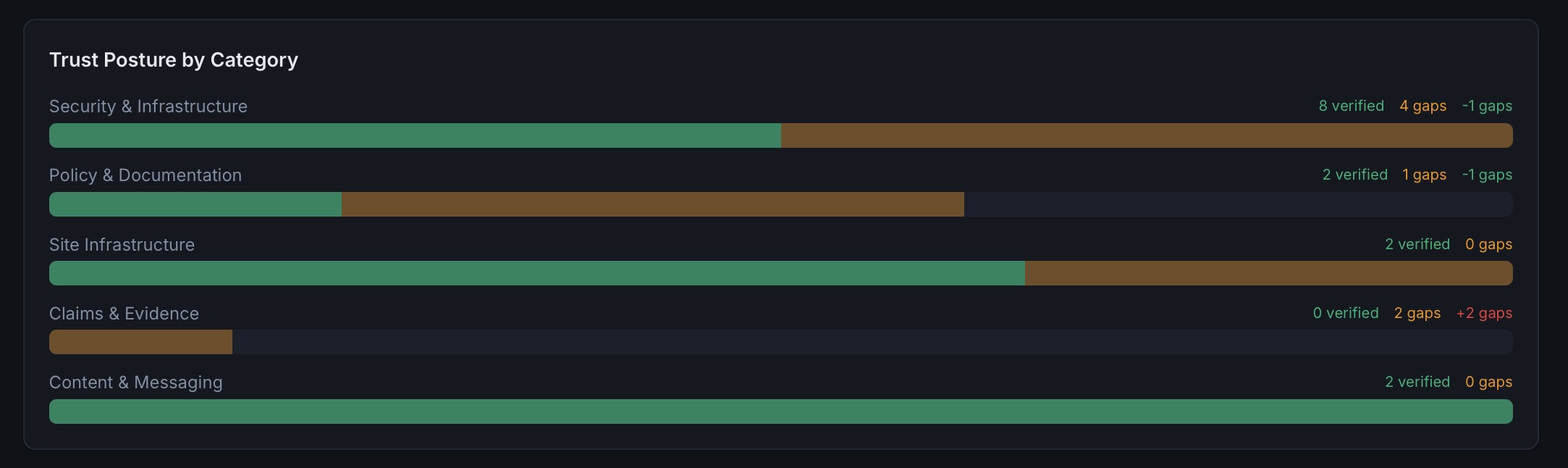
We analyzed trust signals across 12,538 SaaS companies. Here are the seven reasons deals actually die in procurement — ranked by frequency and how easy they are to fix.
1 Your Website Contradicts Your Sales Claims
This is the deal killer nobody talks about. Your sales deck says "enterprise-grade security." Your website is missing basic security headers. Your pitch mentions "SOC 2 compliance." Your site has no evidence of an audit.
Procurement teams are trained to look for contradictions between marketing claims and technical reality. A single contradiction doesn't just flag one issue — it undermines the credibility of everything else you've claimed.
Real example: A SaaS company claimed "bank-level encryption" on their homepage. Their SSL configuration was using TLS 1.0 (deprecated since 2020) with no HSTS header. The deal died not because of the weak TLS — but because the buyer couldn't trust any other claim after finding this one was false.
The fix: Audit every security claim on your website. If you say it, prove it. If you can't prove it, remove the claim. 1-2 hours
2 No Security Page
54% of SaaS companies we scanned have no security page at all. No /security, no /trust, no /compliance — nothing.
From a procurement perspective, this is like a restaurant with no health inspection certificate. Maybe the kitchen is clean. But the absence of visible proof is itself a red flag.
A security page communicates: "we take this seriously enough to document it publicly." That signal matters more than the specific content.
The fix: Create a /security page covering encryption, access controls, infrastructure, incident response, and compliance. Even 500 words dramatically changes how procurement perceives you. 2-3 hours
3 Email Authentication Failures
Invisible to your sales team but glaring to security analysts. If your domain doesn't have SPF, DKIM, and DMARC properly configured, anyone can send emails pretending to be you.
76% of SaaS companies have SPF configured, but only about 30% have DMARC. The gap is a single DNS record.
The fix: Three DNS records. SPF, DKIM, DMARC. Total time for someone with DNS access: 15 minutes
4 Missing or Unreadable Privacy Policy
Two things kill deals here:
- Missing privacy policy — immediate disqualification for any company subject to GDPR or CCPA
- Unreadable privacy policy — dense legal language that obscures practices. Procurement interprets this as deliberately hiding unfavorable terms
67% of SaaS privacy policies score below 30 on the Flesch readability index — requiring a graduate degree to understand. The best companies keep policies readable at a high school level.
The fix: Rewrite in plain English. Use headers. Be specific about data collection, retention, sharing, and deletion. 3-4 hours
5 No Subprocessor Transparency
When a buyer gives you their data, they need to know where it goes. AWS, Stripe, Mixpanel, Sentry — each is a subprocessor that touches customer data.
90% of SaaS companies don't have a subprocessor list. It's one of the easiest trust signals to add and one of the most impactful.
The fix: Create a /subprocessors page listing company name, service, data processed, and country. 1 hour
6 Missing Security Headers
Automated security scanners are standard in enterprise procurement. SecurityScorecard, BitSight, UpGuard — they generate a vendor risk score. A big part comes from five HTTP headers:
- Content-Security-Policy — missing on 47% of SaaS sites
- Strict-Transport-Security (HSTS) — forces HTTPS
- X-Content-Type-Options — one word:
nosniff - X-Frame-Options — prevents clickjacking
- Referrer-Policy — controls URL leakage
Each missing header lowers your automated score. Below the threshold = manual review = weeks added to your cycle.
The fix: Security headers middleware for your web framework. 20 minutes
7 No Evidence of What You Claim
This is the meta-problem. You might have great security. But if there's no public evidence, it doesn't exist to procurement.
Companies that close fastest have one thing in common: every claim is backed by observable evidence. They don't just say "we encrypt data" — their SSL configuration proves it. They don't just say "we handle data responsibly" — their privacy policy, subprocessor list, and security page demonstrate it.
The Math
A typical enterprise deal takes 3-6 months. Procurement adding 4 weeks = 15-25% longer sales cycle.
Across 10 deals at $200K each, that's $300K-$500K delayed annually.
Every issue in this article is externally verifiable. Your buyers are already checking.
See exactly what procurement sees. Free scan. 60 seconds.
Scan Your Site on TrustSignal.tech