
Every SaaS founder has been there. You're in the final stage of a deal worth $50K, $100K, maybe more. Then procurement drops a spreadsheet with 200+ security questions. They need it back in a week.
Your options: pull your CTO off the roadmap for three days, hire a consultant for $5,000, or do it yourself at 11pm wondering what "describe your key management procedures" even means.
There's a better way. After analyzing security postures across 12,000+ SaaS companies, here's what actually works.
Why Most Questionnaires Are the Same
Procurement teams send questionnaires because they need to document that they evaluated your security. It's a compliance requirement — not personal.
The good news: 80% of questions across all major frameworks overlap. SIG Lite, CAIQ, VSA, CIS — they all ask the same things in slightly different words:
- Do you encrypt data at rest and in transit?
- How do you handle access control?
- What's your incident response process?
- Where is data stored?
- Do you do penetration testing?
- What's your data retention policy?
Answer these 6 topics well and you've handled the majority of any questionnaire you'll ever receive.
The Three-Step System
1 Build Your Answer Bank 2-3 hours, once
Take the last questionnaire you received. Answer every question thoughtfully. These become your master answers.
Key principle: answers should reference what's actually true. Don't write aspirational answers. If you don't do penetration testing, say "we conduct regular vulnerability scanning and plan to implement annual penetration testing by Q3." Honest answers that show a plan beat fabricated answers that crumble under follow-up questions.
2 Map Answers to Public Evidence 1 hour
For each answer, link to the public evidence that supports it:
- "Do you encrypt data in transit?" → link to your security page + your HTTPS/HSTS configuration
- "Do you have a privacy policy?" → link directly to your privacy policy URL
- "What compliance frameworks do you follow?" → link to compliance page or SOC 2 report
Procurement teams trust answers backed by independently verifiable evidence. An answer with a link to your security page is worth 10x an answer without one.
3 Send a Pre-Emptive Trust Package 30 minutes
Don't wait for the questionnaire. Send this proactively when a deal enters procurement:
- Your security page URL
- Privacy policy URL
- Subprocessor list URL
- SOC 2 report or security overview document
- Pre-answered top 20 questions from your answer bank
This single email saves 2-4 weeks. Procurement gets what they need immediately, and many will waive the full questionnaire in response.
The 5 Questions That Appear on Every Questionnaire
Q: "Is data encrypted at rest?"
"Yes. All customer data is encrypted at rest using AES-256 encryption. Our database provider [name] manages encryption keys with automatic rotation. Details on our security page: [URL]"
Q: "Is data encrypted in transit?"
"Yes. All data in transit is encrypted via TLS 1.2 or higher. HSTS is enforced with a 1-year max-age and preload."
Q: "How is access to customer data controlled?"
"Access follows the principle of least privilege. Production data access requires MFA + VPN. Access logs are retained for 12 months. Reviews are conducted quarterly."
Q: "Do you have an incident response plan?"
"Yes. Our plan includes: detection → triage (15 min) → containment → notification (72 hours for personal data per GDPR) → remediation → post-mortem. Documented at [security page URL]."
Q: "What compliance certifications do you hold?"
"We are preparing for SOC 2 Type I with expected completion in [quarter]. In the meantime, we follow CIS benchmarks and can provide security controls documentation upon request."
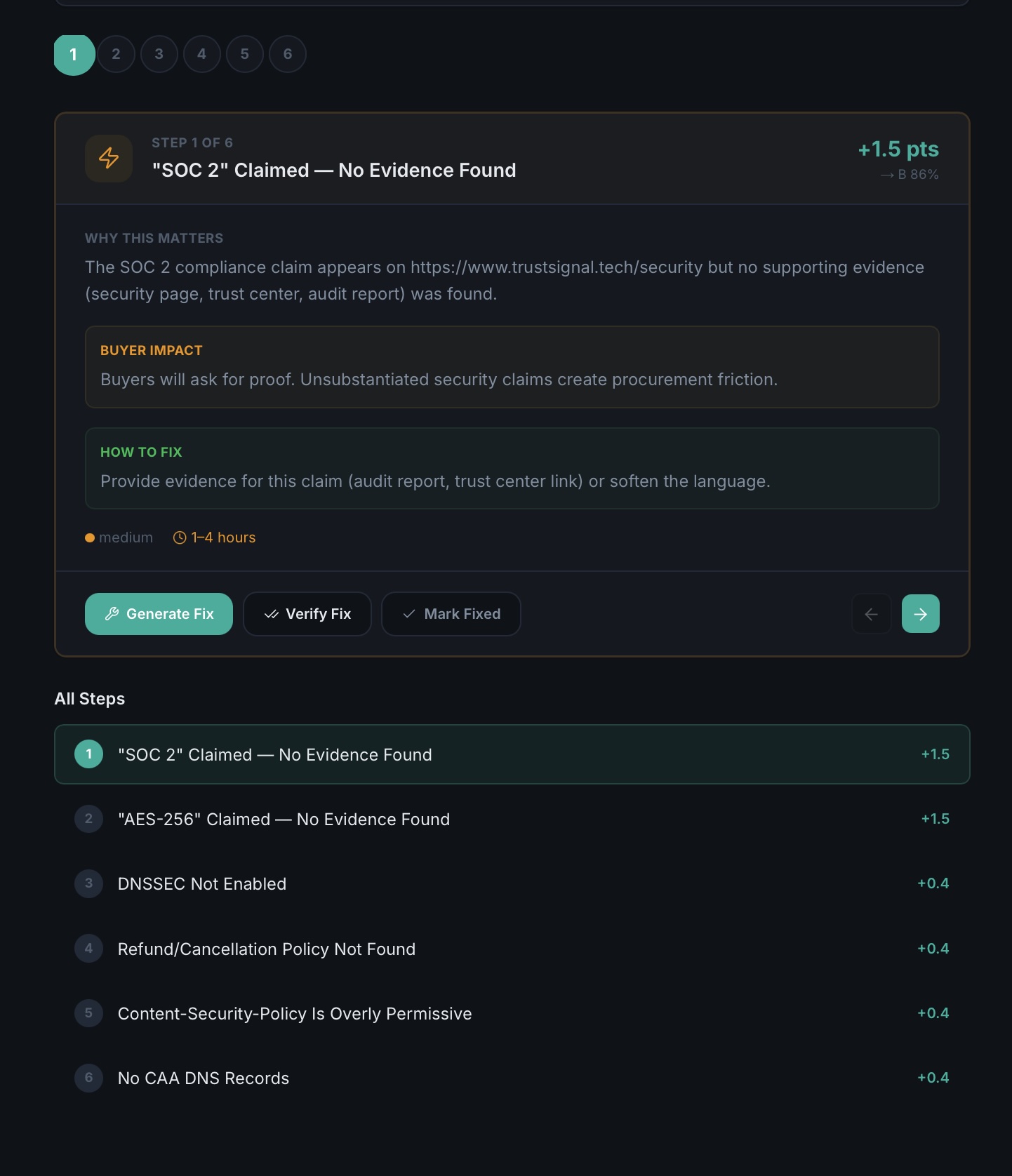
Never claim SOC 2 compliance without a completed audit. Procurement teams verify this. A false claim kills the deal immediately and permanently damages your reputation.
What Procurement Checks Before Reading Your Answers
Before a security analyst even opens your questionnaire, they've already checked your website for:
- Security headers (CSP, HSTS, X-Content-Type-Options)
- Email authentication (SPF, DKIM, DMARC)
- Policy pages (privacy, terms, security, subprocessors)
- SSL certificate validity
- DNSSEC configuration
If any of these are missing, your questionnaire answers lose credibility. What you write in the questionnaire has to match what's publicly verifiable about your company.
See what procurement sees. Auto-generate answers from what's on your site.
Free scan. No signup. 60 seconds.
Scan Your Site on TrustSignal.techThe goal isn't to pass a questionnaire — it's to make procurement so confident that the questionnaire becomes a formality.