
We Scanned 20 Popular SaaS Tools for Trust Readiness — Here's What We Found
Using TrustSignal's outside-in scanner, we analyzed the publicly verifiable trust posture of 20 well-known SaaS companies. The results reveal widespread gaps that buyers, procurement teams, and competitors can see — even if the vendors can't.
When enterprise buyers evaluate a new SaaS vendor, they don't just look at the product demo. They do their own homework. They check your security page, read your privacy policy, verify your email authentication, look for a status page, and compare you against alternatives.
The question is: do you know what they find?
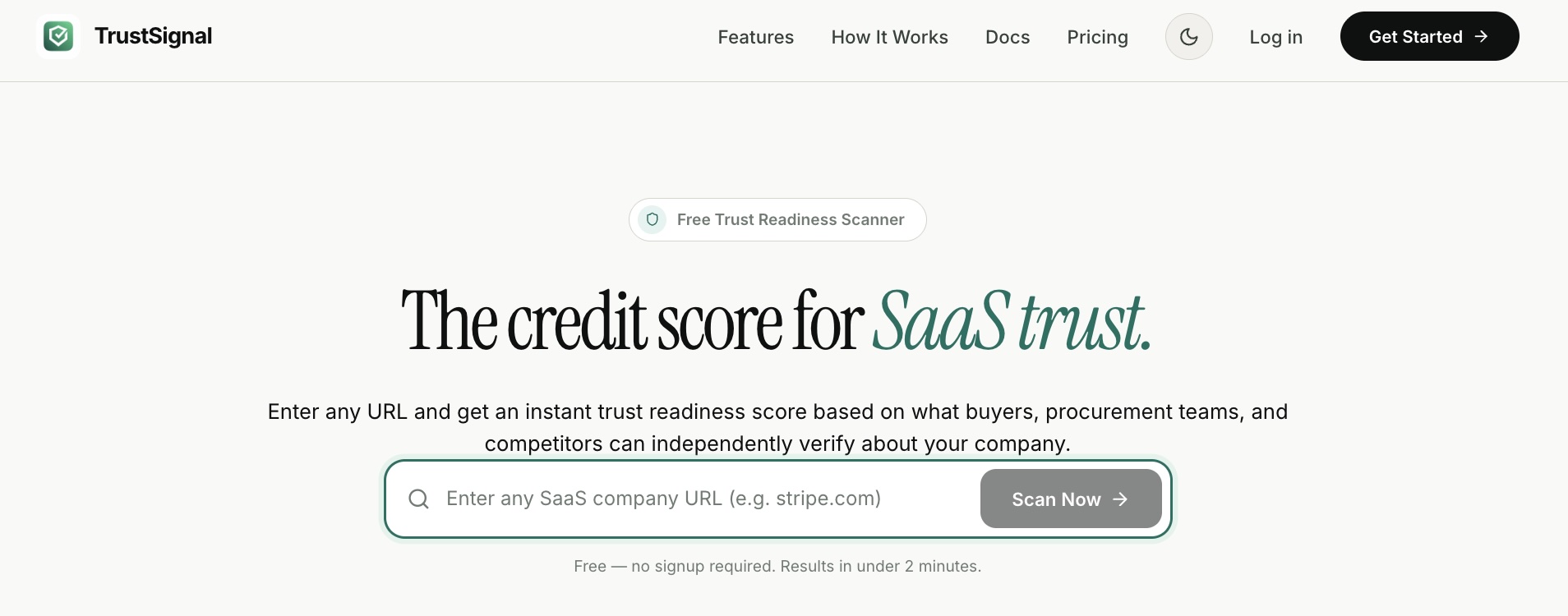
We built TrustSignal to answer that question. It scans the public-facing presence of any SaaS company — security headers, policies, legal documentation, email authentication, and more — and produces a Trust Readiness Score based on what anyone can independently verify.
To test it, we scanned 20 popular SaaS tools across six categories: project management, developer tools, marketing, HR, finance, and analytics. We didn't cherry-pick — these are well-known companies that thousands of teams rely on every day.
Here's what we found.
The Key Numbers
100%of the SaaS companies we scanned had at least one critical trust gap that a buyer could identify in under 60 seconds.
What We Checked
TrustSignal evaluates publicly accessible signals across three core categories. Every check looks at what is externally visible — nothing requires vendor cooperation or internal access.
Findings by Category
We're not naming specific companies or publishing individual scores — this isn't about shaming anyone. Instead, we're sharing the patterns we found across all 20 companies. These patterns reveal industry-wide gaps that affect buyer confidence.
🔒 Security & Headers Avg: C
This was the most inconsistent category across our sample. While most companies had valid SSL certificates (which is table stakes in 2026), the deeper security signals showed significant gaps.
- DMARC: 9 out of 20 companies had missing or misconfigured DMARC records. This means their domain can be spoofed in phishing emails — a risk that any buyer's security team can check in seconds.
- Content Security Policy: 8 out of 20 had either no CSP header or an overly permissive one. A strong CSP protects against cross-site scripting attacks and signals mature security practices.
- HSTS: 4 out of 20 were not enforcing HTTP Strict Transport Security, leaving users vulnerable to downgrade attacks.
- Security Page: 12 out of 20 had a dedicated security page. Of those, 8 mentioned SOC 2 compliance and 5 had a bug bounty program.
📋 Policy & Documentation Avg: D
Most companies had the basics — a privacy policy and terms of service existed and were accessible. But the depth and completeness varied significantly.
- Privacy Policy Completeness: 3 out of 20 had no discoverable privacy policy at all. Of the 17 that did, 14 were missing critical elements like data retention periods, specific third-party sharing practices, or user deletion rights.
- Last-Updated Date: 11 out of 20 privacy policies had no visible last-updated date. Buyers want to know if a policy reflects current practices or is years out of date.
- Subprocessor List: Only 4 out of 20 published a public list of subprocessors. This is increasingly expected by enterprise buyers, especially under GDPR, and its absence raises immediate red flags in procurement.
- AI/ML Disclosure: Only 5 out of 20 had any mention of how they use AI or machine learning with customer data. As the EU AI Act takes effect, this gap will become a dealbreaker.
⚙️ Operational Signals Avg: C
Beyond security and policies, we looked for signals that indicate operational maturity and ongoing investment in trust.
- Status Page: 14 out of 20 had a public status page. Having one signals transparency about uptime and incident management.
- Cookie Consent: 16 out of 20 had a proper cookie consent mechanism. 13 used cookies with the Secure flag, and 11 set HttpOnly on session cookies.
The uncomfortable truth: Every gap we found is something a buyer can verify independently in minutes. If your procurement team is checking vendors, they're checking these signals. If you haven't checked your own, your competitors might be checking for you.
What This Means for SaaS Companies
The days of "trust us" are over. Enterprise buyers in 2026 have access to more verification tools than ever. Security teams run their own assessments. Procurement adds compliance requirements to every RFP. And competitors use publicly available information to position themselves as the more trustworthy alternative.
The companies that scored well in our scan shared three common traits:
- They treated trust as a product feature, not a checkbox. Their security pages were detailed, their policies were current, and their documentation was comprehensive.
- They were transparent by default. Public subprocessor lists, visible last-updated dates on policies, dedicated security pages with specific compliance details.
- They invested in the signals that buyers actually check. Not just SOC 2 badges, but the full spectrum of publicly verifiable indicators — from email authentication to cookie configuration.
The companies that scored poorly weren't necessarily insecure. Many of them likely have strong internal security practices. But if those practices aren't visible externally, they might as well not exist from a buyer's perspective.
How Does Your Company Score?
We built TrustSignal so any SaaS company can see exactly what the outside world sees when they look at your public-facing presence. The scan takes less than 60 seconds, requires no signup, and is completely free.
Check Your Trust Readiness Score
See what buyers, procurement teams, and competitors can verify about your company — in 60 seconds.
Scan Your Company Free →Methodology Note
All scans were performed using TrustSignal's automated scanning engine during the week of February 17, 2026. We scanned only publicly accessible information — no internal systems, authenticated pages, or private data were accessed. Companies were selected based on popularity and recognition across six SaaS categories, not based on expected results. Individual company scores are not published in this report; we are sharing aggregate patterns only.
TrustSignal is a trust readiness indicator. It is not a certification, audit opinion, or legal determination. Our scoring methodology is published and transparent.
Want to be notified when we publish our next Trust Readiness Report? Visit TrustSignal.tech and join the mailing list.